Open-source AI project OpenClaw has pulled off a surprising milestone on GitHub, surpassing the popularity of React in total stars.
On March 2, OpenClaw crossed 2,45,000 stars, edging past React’s roughly 2,43,000 stars on the developer platform. GitHub stars, for context, reflect how many users have bookmarked or shown interest in a repository, often serving as a rough indicator of community support and visibility.

React isn’t the only heavyweight OpenClaw has overtaken. The project has also moved ahead of Python (around 2,18,000 stars) and even the Linux kernel (about 2,20,000 stars), making its rapid rise even more striking.
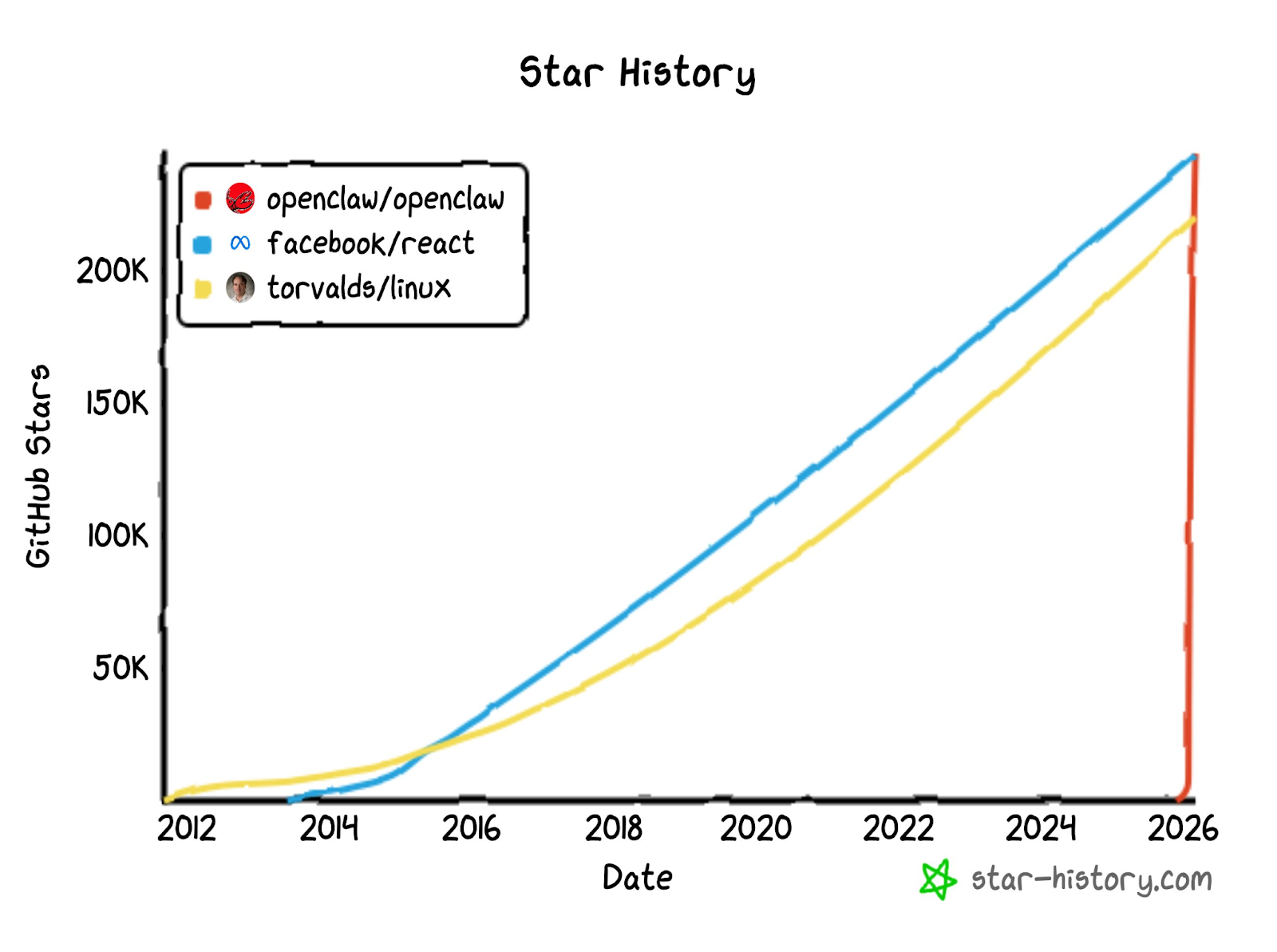
In a celebratory post on X, the OpenClaw team described the moment with humor, noting that a personal AI assistant created by “a lobster-obsessed Austrian” and a passionate community had just surpassed a framework that powers a significant portion of the internet.
Originally launched as a hobby project in late 2025 by Austrian engineer Peter Steinberger, OpenClaw began under different names before gaining momentum. What set it apart was its ability to run autonomous AI agents locally, capable of handling practical digital tasks. The framework connects large language models — including OpenAI’s GPT and Anthropic’s Claude — with real-world tools and services on a user’s device or server.

Once set up, users can interact with OpenClaw through chat platforms such as WhatsApp, Telegram, and Discord. From there, they can instruct it to carry out actions like clearing inboxes, sending messages, scheduling calendar events, organising files, or even executing shell commands and scripts. The emphasis on local control and workflow automation helped the project gain traction quickly within developer circles.
The journey, however, was not without hurdles. When the project was first introduced in November 2025 under the name “Clawdbot,” Anthropic reportedly raised trademark concerns, likely due to similarities with its Claude model branding. Steinberger subsequently renamed the project to Moltbot in January 2026, before eventually settling on OpenClaw — a name that retained its original theme while distancing it from the dispute.
More recently, Steinberger joined OpenAI to work on next-generation personal AI agents. Despite his move, OpenClaw will continue as an open-source initiative, with OpenAI supporting it as an independent foundation. The arrangement aims to preserve the project’s community-driven ecosystem while also linking it more closely with ongoing advances in AI agent development.
What began as a niche experiment has now become one of the most starred repositories on GitHub — a rare achievement in the competitive world of open-source software.
Also Read: OpenClaw’s AI Assistants Are Building a Social Network of Their Own