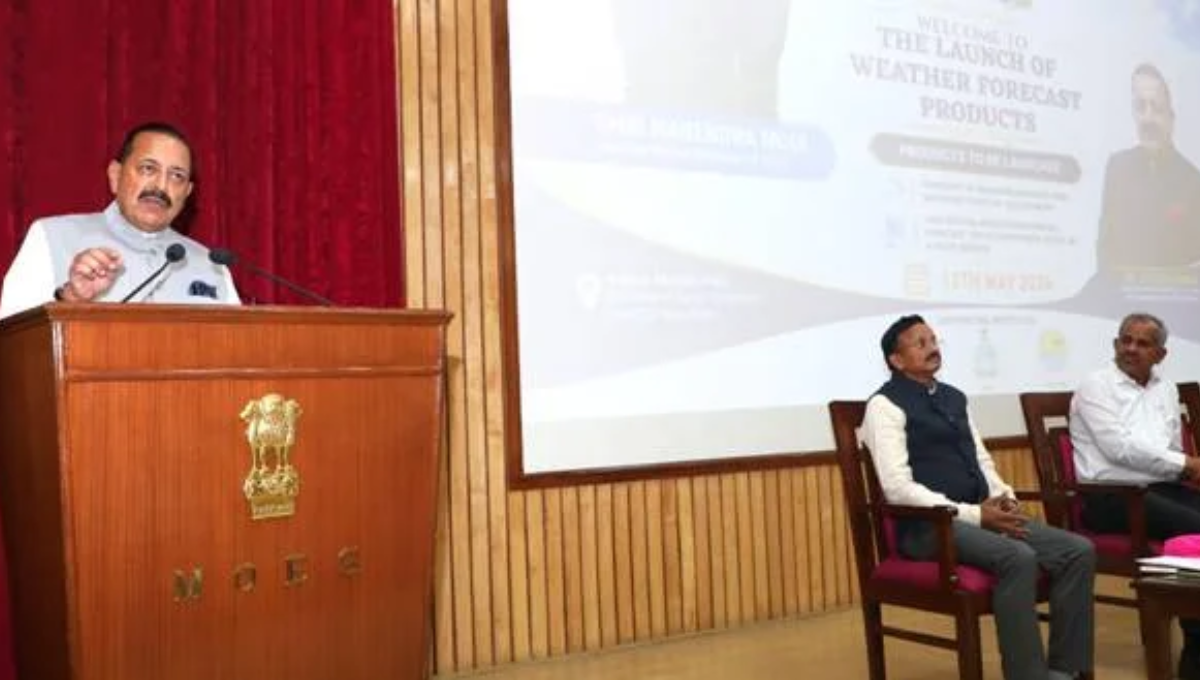
India has launched two new artificial intelligence-powered weather forecasting systems aimed at improving hyperlocal weather predictions and helping authorities strengthen disaster management, farming decisions and public planning.
Union Minister Jitendra Singh introduced the new AI-based services on Tuesday under the Ministry of Earth Sciences. The systems include an AI-powered “Forecast of Monsoon Advance over Different Parts of the Country” and a pilot “High Spatial Resolution Rainfall Forecast for Uttar Pradesh.”

The forecasting platforms were jointly developed by the India Meteorological Department, the Indian Institute of Tropical Meteorology in Pune, and the National Centre for Medium Range Weather Forecasting.
Speaking at the launch event in New Delhi, Singh said India’s weather forecasting capabilities have significantly improved over the last decade due to better technology, upgraded forecasting models and stronger observation networks.
He added that the India Meteorological Department now plays a much bigger role not only in weather updates, but also in governance, disaster preparedness, agriculture planning and day-to-day public decision-making.

According to the ministry, the AI-based monsoon forecasting system will issue probabilistic forecasts every Wednesday, predicting the advance of the monsoon up to four weeks ahead. The service is expected to support farmers across 16 states and more than 3,000 sub-districts through the Ministry of Agriculture and Farmers’ Welfare’s outreach network.
The platform combines AI forecasting models, statistical methods and extended-range weather prediction systems to deliver more practical and operational forecasts for agriculture and rural planning.
The second system, currently launched as a pilot project in Uttar Pradesh, is designed to generate rainfall forecasts with a spatial resolution of 1 kilometre up to 10 days in advance. It uses AI-based downscaling techniques along with data collected from Doppler weather radars, satellites, automatic rain gauges and weather stations.
Singh said the initiative reflects India’s move from traditional forecasting methods toward impact-based and decision-support forecasting that can provide highly localised and actionable weather information.
The minister also highlighted the rapid expansion of India’s weather monitoring infrastructure. He noted that the number of Doppler weather radars in the country has increased from around 16 a decade ago to nearly 50 today, with another 50 expected to be added under the government’s Mission Mausam programme.
Also Read: Dell Technologies Unveils AI India Blueprint at India AI Impact Summit 2026