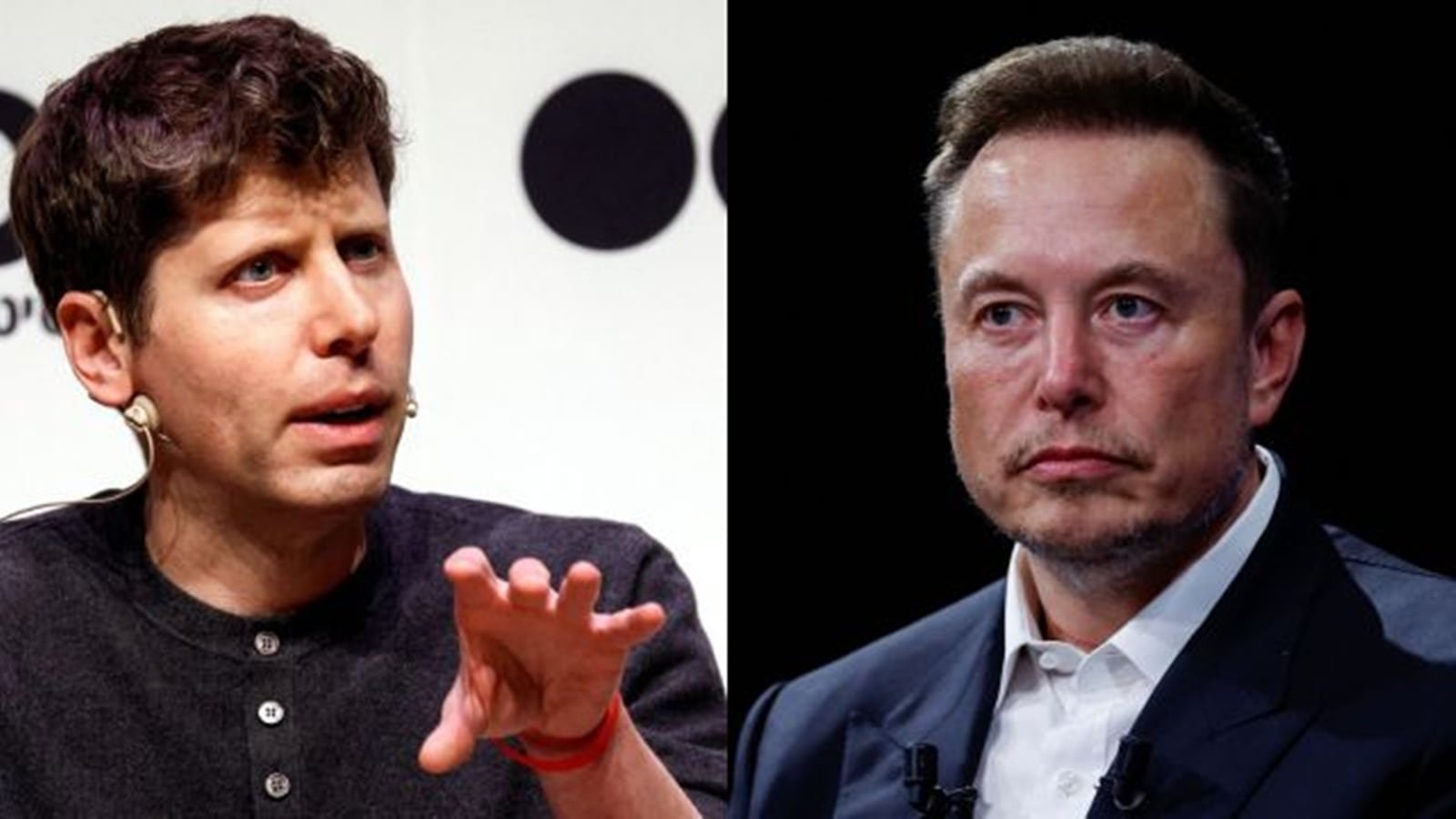
Elon Musk and Sam Altman have continued to spar publicly for months, even as the artificial intelligence systems built by their companies become more deeply connected behind the scenes. A growing concern is now emerging around how AI models source and recycle information — particularly through Musk-owned platforms.
The latest large language model powering ChatGPT, GPT-5.2, has reportedly cited Grokipedia, an AI-generated encyclopedia developed by Musk’s xAI, while responding to a wide range of user queries. These references appeared across topics ranging from Iran’s political system to discussions involving Holocaust denial. In several instances, Grokipedia was cited repeatedly within a relatively small set of questions, signaling its rising visibility among AI systems.

Other major AI chatbots are also drawing from the same source. Claude, developed by a rival AI firm, has referenced Grokipedia while answering questions related to subjects such as oil production and regional beer traditions. This growing pattern suggests Grokipedia is positioning itself as a fast-growing alternative to Wikipedia — but not without controversy.
Unlike Wikipedia, which relies on human editors and community moderation, Grokipedia is generated entirely by large language models. Critics warn that this structure increases the risk of factual errors and hallucinations. Because AI systems can confidently present incorrect information, mistakes introduced into one model can easily spread across others, creating a self-reinforcing loop of misinformation that becomes difficult to trace or correct.
Concerns about this approach surfaced soon after Grokipedia’s launch in October 2025. Wikipedia’s co-founder publicly questioned the reliability of AI-written encyclopedia entries, warning that current language models are not yet accurate enough to handle fact-based reference material without significant errors.

The issue becomes more complex when AI chatbots begin citing each other’s outputs. When flawed information enters one system and is reused by another, it can quietly gain credibility simply through repetition. Once embedded into AI responses, misleading claims are harder to remove and may continue circulating long after being debunked elsewhere.
OpenAI has stated that its web-enabled models aim to draw from a wide range of publicly available sources and perspectives, while applying safety filters to reduce exposure to harmful or unreliable content. The company has also said it clearly displays citations to show where information originates and is working on tools to limit the influence of low-credibility material and coordinated manipulation efforts.
According to reports, ChatGPT avoided citing Grokipedia when prompted with well-known misinformation topics such as the January 6 Capitol attack or claims of media bias. However, on more obscure or technical subjects, the chatbot appeared more willing to rely on the AI-generated encyclopedia and delivered responses with greater confidence — even when the information was later shown to be misleading.
In one example, the chatbot reportedly repeated already-disproven claims related to a historian’s role in a high-profile trial, again citing Grokipedia as a source.
What is Grokipedia?
Grokipedia functions as a searchable database of AI-written articles. Each entry includes a timestamp indicating the last update and is labeled as being “fact-checked by Grok,” xAI’s chatbot. Unlike Wikipedia, users cannot directly edit articles. Instead, they may suggest corrections or flag inaccuracies through a feedback form.
Some entries include a disclaimer noting that portions of the content are adapted from Wikipedia under a Creative Commons license. However, the platform does not offer the same level of transparent editorial oversight or community review that Wikipedia relies on.
Musk has previously defended the idea of an AI-generated encyclopedia, arguing that removing human authorship could eliminate political or ideological bias. Critics counter that while human bias is imperfect, replacing it entirely with AI systems introduces new risks — particularly when those systems learn from one another.
As AI tools increasingly shape how people access information, the debate around sources, accountability, and truth in the age of machine-generated knowledge is becoming harder to ignore.
Also Read: Moxie Marlinspike Introduces a Privacy-Focused ChatGPT Alternative